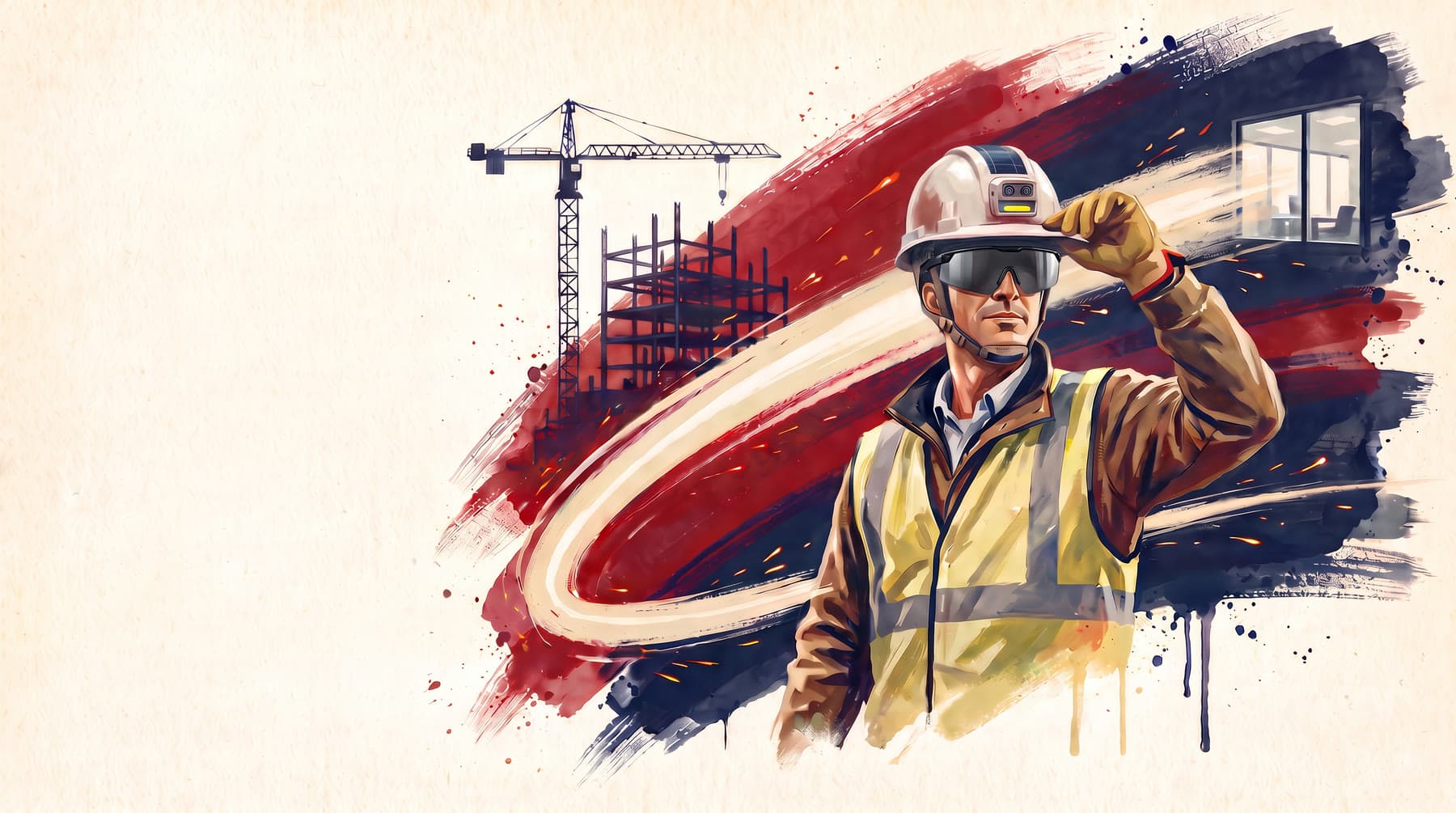
FieldTec Journal / Safety & Technology
Talk Is a Safety Control
Why communication sits at the root of most incidents, and how AI and headsets are closing the gap between the site and the office.
Every safety professional has read an incident report where the hazard was known. Someone saw it. Someone mentioned it at a toolbox talk, or wrote it on a form that sat in a truck until Friday. The information existed. It just didn't reach the right person in time.
That gap between knowing and telling is where a lot of injuries live. The research backs this up, and it points to something practical: if we treat communication as a control, the same way we treat guardrails and lockout, we can engineer it. Artificial intelligence and immersive headsets are the first tools in a long time that change how fast a warning travels from the person who sees it to the person who can act on it.
Communication failures show up in the root cause
The most cited study on this comes from Loughborough University. Haslam and colleagues investigated 100 construction accidents in detail, interviewing the people involved and their supervisors.1 Problems with the worker or work team, which included communication within the crew, appeared in 70% of accidents. Shortcomings in risk management showed up in 84%.
What contributed to 100 construction accidents
Share of accidents where factor was presentFactors overlap; most accidents had several. Source: Haslam et al., Applied Ergonomics 36(4), 2005.
Those two top categories are, at heart, about information flow. Risk management breaks down when hazard knowledge doesn't move up to the people who plan the work. Team problems often come down to instructions that were unclear, not understood, or never given. Other researchers reach the same conclusion from the project side: studies of ineffective communication on construction projects list a high accident rate among its main effects, alongside cost and schedule overruns.2
“The hazard was known. The information existed. It just didn't reach the right person in time.”
AI turns observation into a message that travels
For most of the history of site safety, the eyes on the job were human, and there were never enough of them. Computer vision changes the arithmetic. A camera watching a work area doesn't get tired at 3 p.m. and doesn't miss a missing hard hat because it's looking the other way.
The science here is mature. A study in Frontiers in Built Environment trained a deep learning model on 2,509 images from real construction sites to classify workers as safe or missing a hard hat or vest. It scored an F1 of 0.96, and when it flagged a worker as not safe it raised an alarm and created a time-stamped report.3 A separate framework for real-time monitoring determined whether workers were wearing their PPE with 91.3% accuracy.4 Newer work pairs vision with language models so the system can describe a hazard in words rather than just drawing a box around it.5
What matters for communication is that last step. Detection on its own is a data point. Detection that becomes a notification to the right supervisor, logged against the right area and task, is a message. That is where AI earns its place: it shortens the time between a hazard existing and a decision-maker knowing about it, and it leaves a record that feeds trend analysis instead of disappearing into someone's memory.
Headsets put the office on the site
The first wave of consumer VR, led by headsets like the Oculus Rift, made immersive hardware affordable enough for training rooms. That line has since moved on to standalone headsets such as the Meta Quest, which need no tethered PC and can run on a job site.
Training is where the evidence is strongest. A 2024 meta-analysis in the Journal of Safety Research pooled a decade of studies comparing VR with traditional construction safety training and found VR significantly more effective.6 A broader review of 52 studies across industries reached the same conclusion, with construction and fire safety the most common uses since 2018.7
How much better VR training performed
Standardized mean difference vs. traditional methodsBars scaled 0 to 1.0. By convention 0.2 is a small effect, 0.5 medium, 0.8 large.
Source: Man, Wen & So, Journal of Safety Research 88, 2024.
The bigger shift is live collaboration. A review of augmented reality for remote work across architecture, engineering and construction found it cut task time, errors and workload, and improved the accuracy of risk communication on projects.8 Picture a safety manager in the office wearing a headset, looking at the same 3D model a crew is standing inside, and dropping a marker exactly where the exclusion zone should start. There is no ambiguity about "the left side of the bay" when both people can see the pin.
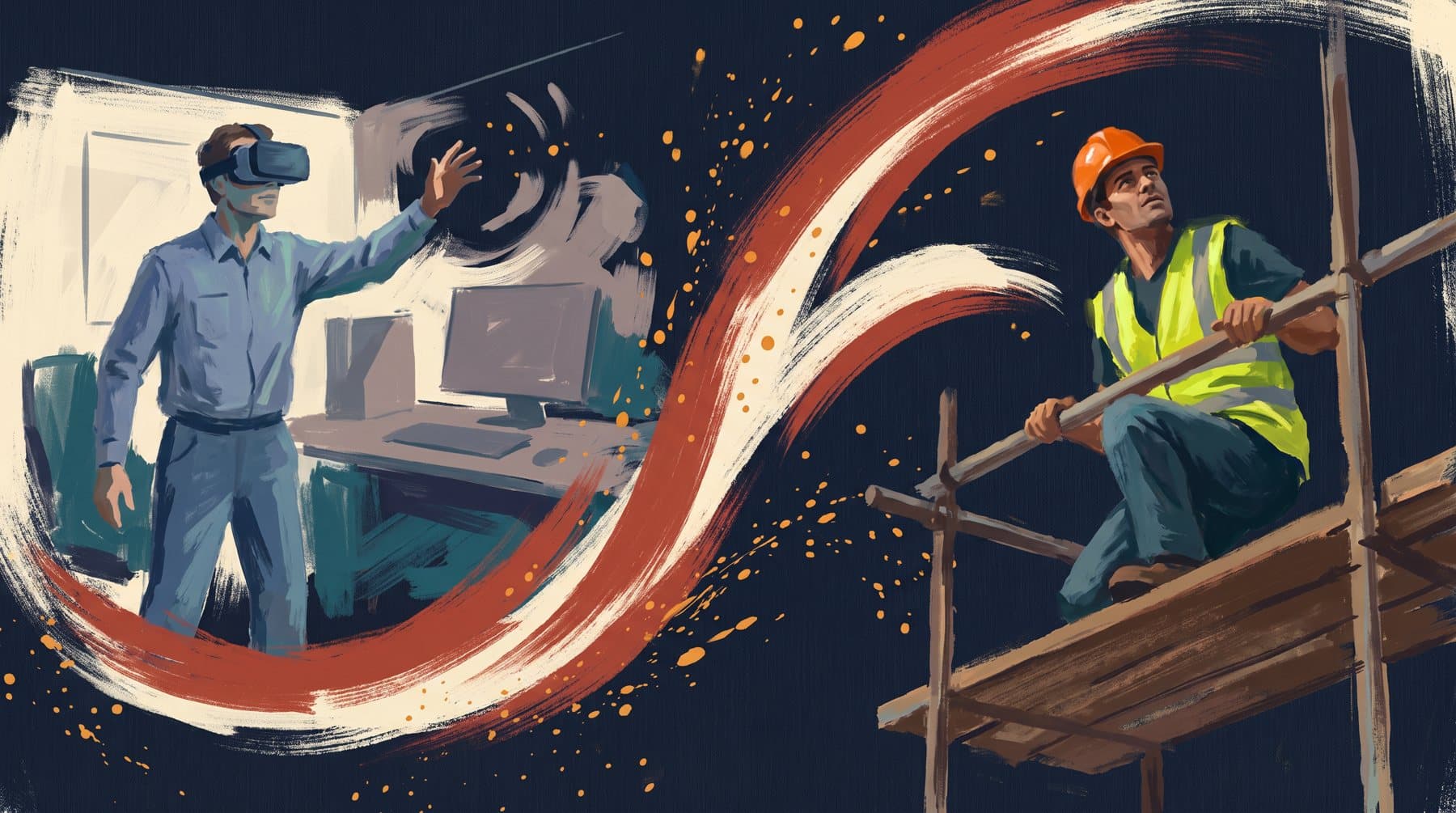
A caution, though. The hardware market moves fast. Meta shut down its Horizon Workrooms meeting app on February 16, 2026 and stopped selling commercial Quest headsets that same month.9 Meetings in a headset still work through apps like Microsoft Teams Immersive and Zoom Workplace, but the lesson for safety leaders is plain: don't build your communication system around one vendor's app. Build it around your own data, so that when the headset changes, your hazard records, sign-offs and corrective actions don't.
What the next hard hat could look like
If headsets bring the office to the site, the hard hat is the obvious place to carry the rest of the kit. Here is one concept we've been sketching: a full-brim hat with a thin solar strip along the crown, a small front module with a camera and light, and a wide shield lens, like a pair of sport safety glasses, that slides down from under the brim.
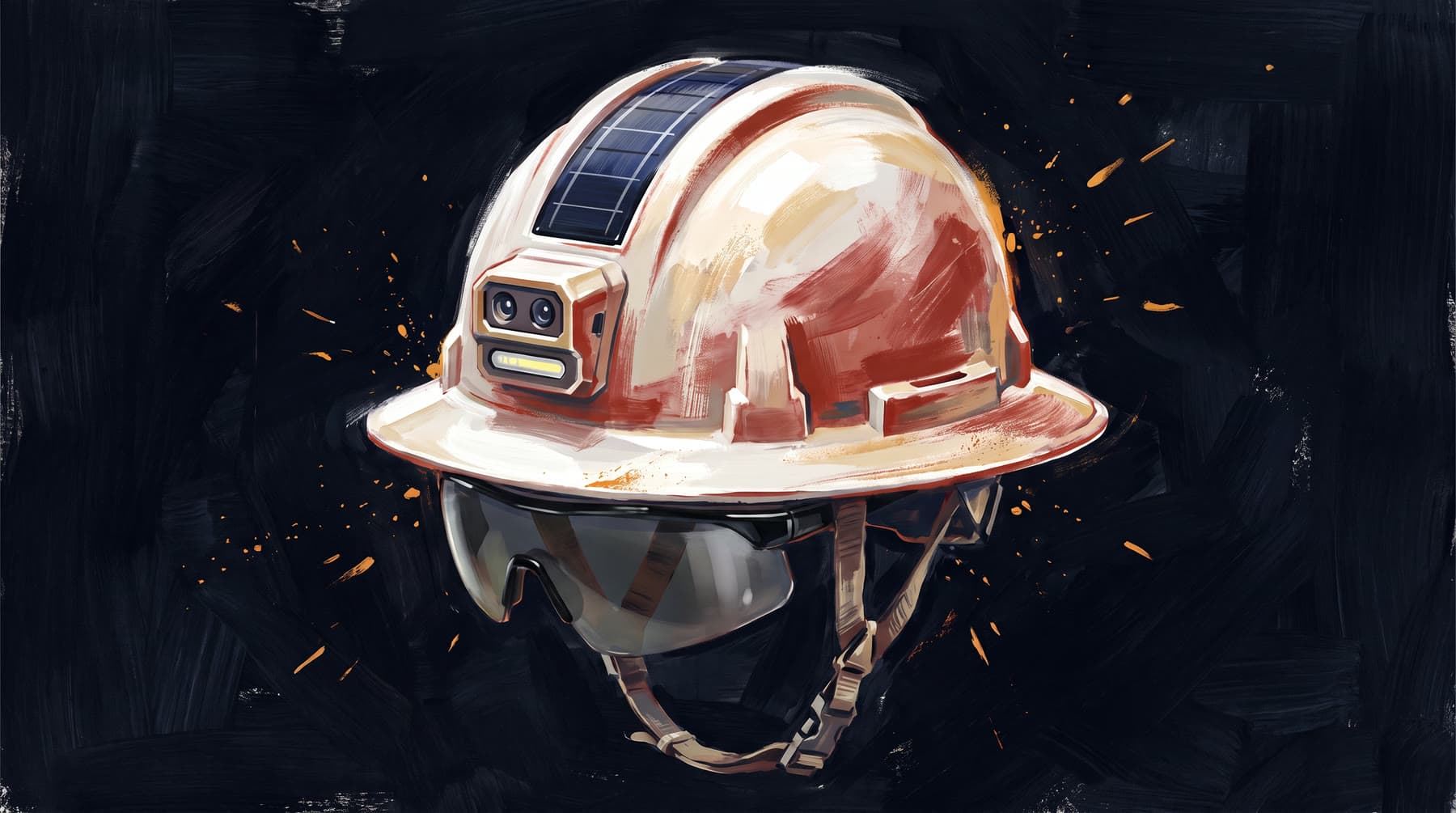
The appeal is that the parts help each other. A strip of solar cells on the crown won't run a display, but in good light it can produce a watt or two, enough to keep a small fan, a light and a location beacon going. Point that fan across the inside of the lens and it cools the worker and keeps the lens from fogging. The camera gives a remote supervisor the worker's view when they need to guide a task, and the beacon can raise a man-down alert.
The hurdles are real. Any hard hat has to be certified as a complete system under CSA Z94.1 in Canada or ANSI Z89.1 in the U.S., so electronics can't simply be added to an approved shell. Solar cells and wiring on the crown would likely rule out a high-voltage electrical rating. The shield lens has to meet eye-protection standards on its own (CSA Z94.3 or ANSI Z87.1) and sit close enough to the face to stop debris, even though it hangs from a hat that shifts on its suspension. For dust or splash work, workers would still need sealed goggles. None of that makes the idea wrong. It makes it a job for a helmet manufacturer, with the data flowing into the safety system you already run.
How the loop closes
Put the pieces together and you get a communication loop that runs in minutes instead of days.
The connected site loop
From hazard to verified controlEvery handoff is a place where a message can be lost. Each stage should leave a record.
The value isn't in any single gadget. It's in removing the waits: the wait for someone to notice, the wait for the form to be handed in, the wait for the right person to be on site, and the wait to confirm the fix actually happened.
Where to start
You don't need a headset for every supervisor on day one. Start with the parts that move information faster today:
- Get hazard observations and near misses onto a phone form that notifies someone the moment it's submitted, not at the end of the week.
- Make sure every alert lands with a named owner and a due date, so a flag becomes an action.
- Pilot VR training on one high-risk task where the research is strongest, such as working at heights or hazard recognition.
- Trial remote video or XR guidance for inspections where the expert can't always be on site.
- Keep your records in a system you control, independent of any one hardware vendor.
AI won't replace the conversation between a foreman and a crew at the start of a shift. It shouldn't. What it can do is make sure that when someone sees something wrong, the message travels farther and faster than it ever could on a clipboard. In safety, the speed of a message is often the difference between a near miss and a claim.
References
- Haslam, R.A., Hide, S.A., Gibb, A.G.F., et al. (2005). Contributing factors in construction accidents. Applied Ergonomics, 36(4), 401–415. doi.org/10.1016/j.apergo.2004.12.002
- Studying the relationship between causes and effects of poor communication in construction projects using PLS-SEM approach (2021). Journal of Facilities Management. emerald.com
- Delhi, V.S.K., Sankarlal, R. & Thomas, A. (2020). Detection of PPE compliance on construction site using computer vision based deep learning techniques. Frontiers in Built Environment, 6, 136. frontiersin.org
- Deep learning-based framework for monitoring wearing personal protective equipment on construction sites (2023). Journal of Computational Design and Engineering, 10(2), 905. academic.oup.com
- Chen, Z., Chen, H., Imani, M., et al. (2025). Vision language model for interpretable and fine-grained detection of safety compliance in diverse workplaces. Expert Systems with Applications, 265. arxiv.org
- Man, S., Wen, H. & So, B.C.L. (2024). Are virtual reality applications effective for construction safety training and education? A systematic review and meta-analysis. Journal of Safety Research, 88, 230–243. sciencedirect.com
- Virtual reality for safety training: A systematic literature review and meta-analysis (2023). Safety Science. sciencedirect.com
- Application of augmented reality for remote collaborative work in architecture, engineering, and construction (2022). Proceedings of the Human Factors and Ergonomics Society Annual Meeting. journals.sagepub.com
- Meta (2026). Meta Horizon Workrooms is being discontinued. Meta Quest Help Center. meta.com
Illustrations generated with Runway. The hard hat shown is a concept, not a real product.
Keep reading