FieldTec Journal / Workforce
Level Up the Crew
The site is changing hands from boomers to millennials and Gen Z. Compliance, done right, is the bridge between how they learn.
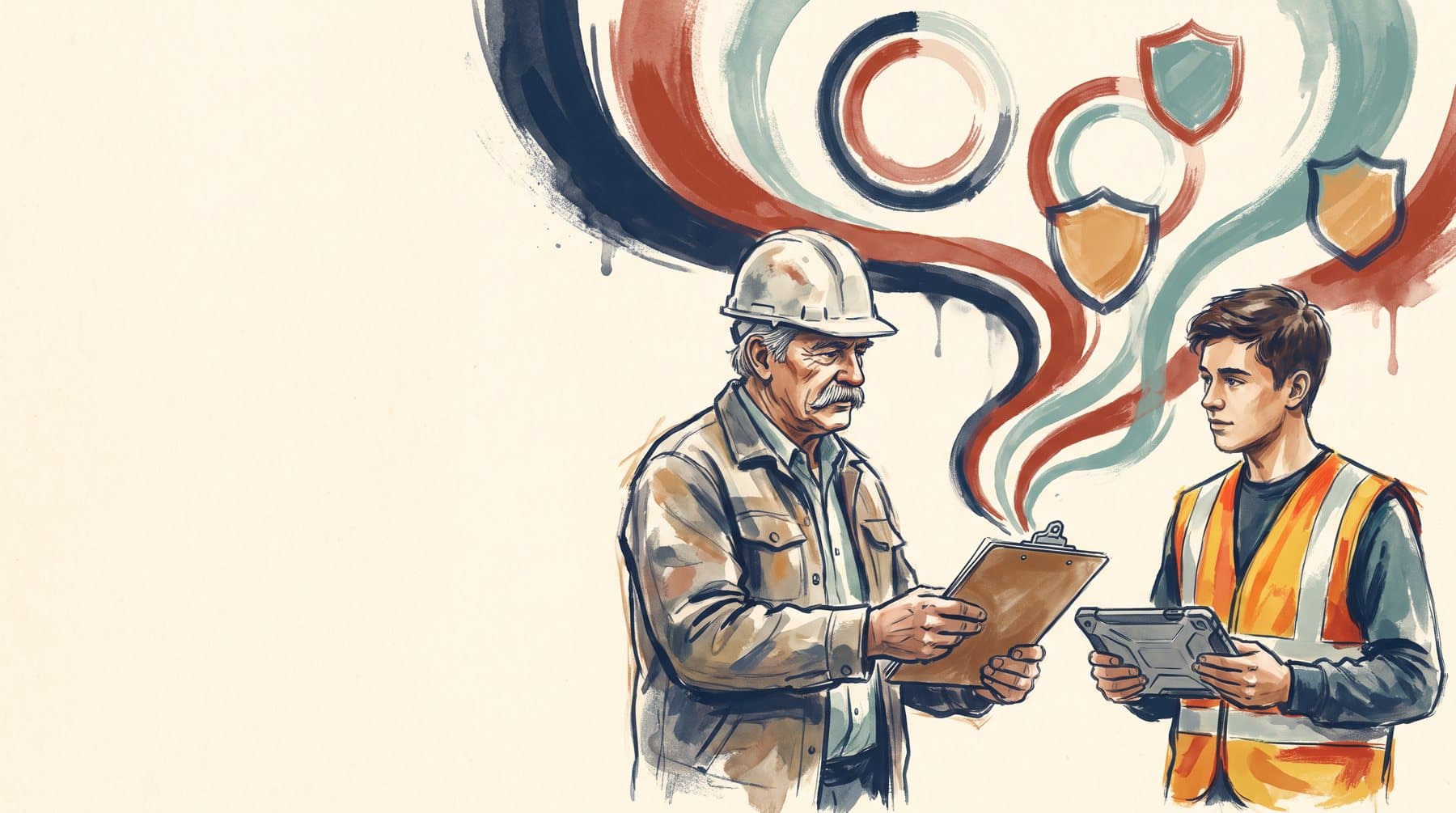
Walk any large site today and you'll see two ways of working side by side. The superintendent who learned the trade from a mentor and a binder, and the second-year apprentice who learned most of what they know from a screen. Both want to go home safe. They just expect the information to reach them differently.
That handover is happening fast. The question for safety leaders isn't whether to change how we train and track compliance. It's how to change it without losing what the veterans know, and without turning safety into a video game that rewards the wrong things.
The handover is already underway
BuildForce Canada's latest ten-year outlook shows the scale of it. The industry needs to hire hundreds of thousands of workers over the coming decade, much of it to replace people retiring, and most of the new recruits will be under 30.1
Canada's construction workforce, next ten years
BuildForce Canada projectionsResidential alone expects about 135,000 retirements by 2035. Source: BuildForce Canada, Construction and Maintenance Looking Forward 2026–2035.
Every retirement takes decades of hazard recognition off the site. Much of it was never written down. It lived in the foreman's head and moved to the next generation through conversation, one crew at a time. That model doesn't scale to a quarter-million new workers.
Different generations, same brain
It's easy to overstate the generational divide. A meta-analysis of 20 studies found that differences in work attitudes such as job satisfaction and commitment between generations were small, and often explained by age and career stage rather than birth year.2 A 22-year-old boomer in 1980 was also impatient with binders.
What has changed is the environment. Younger workers grew up with instant feedback: a progress bar, a notification, a streak. They're used to seeing where they stand. Traditional compliance gives almost none of that. You sign the orientation form, you get a ticket, and you hear nothing until something goes wrong. The gap isn't in values. It's in feedback.
“The gap between generations isn't in values. It's in feedback.”
What the research says about gamified safety
Gamification means using game elements such as points, levels, badges, progress and challenges in a work setting. In safety training it has real evidence behind it, with caveats.
A randomized field trial in Italy compared a one-day gamified safety course with the standard version across 77 workers. Both groups improved significantly. The gamified group scored slightly higher afterward, 10.8 against 10.0 on a 15-point knowledge test, and the authors reported better engagement.3 Studies in civil construction have explored games, apps and simulators for safety training with similar positive but modest results.4 VR training, which is often built like a game, shows stronger effects in meta-analysis.5
The honest summary: gamification makes training more engaging and helps knowledge stick a little better. It is not a miracle. Researchers have also flagged a burnout risk when the pressure of leaderboards and constant scoring outweighs the fun.6
The trap: rewarding silence
Safety has tried points and prizes before, and it has a bad track record when the prize is tied to a low injury count. Reward crews for zero recordables and you teach them not to report. OSHA has addressed this directly: incentive programs that reward reporting hazards, near misses and participation are encouraged, while programs based on injury rates must not discourage people from reporting.7
This is where compliance becomes the bridge. Compliance activities are exactly the leading indicators you want more of, and they're naturally measurable.
What to put points on
Reward the behaviour, never the outcomeReward these
- Near misses and hazard observations submitted
- Daily hazard assessments done before work starts
- Inspections completed on time
- Corrective actions closed
- Training modules and certifications earned
- Mentoring an apprentice through a task
Never reward these
- Days without a recordable injury
- Low incident counts per crew
- Fewest claims filed
- Speed of form completion alone
- Leaderboards that shame the bottom crew
Based on OSHA's 2018 interpretation of 29 CFR 1904.35(b)(1)(iv) and common practice in safety leadership.
Where AI and hardware fit
Gamification only works if the scoring is fair and automatic. Nobody wants a safety coordinator hand-counting points on a whiteboard. This is the job for software and devices.
Turning compliance into progress
Requirement, mechanic, enabler| Compliance task | Game mechanic | AI or hardware that makes it work |
|---|---|---|
| Daily hazard assessment | Streaks for completing before first task | Mobile form with time stamp; AI suggests hazards the crew missed |
| Hazard and near-miss reporting | Points per quality report, bonus when it leads to a fix | Photo capture; AI classifies the hazard and routes it to an owner |
| Training and tickets | Levels and skill badges tied to real certifications | VR modules for high-risk tasks; LMS tracks expiry automatically |
| Inspections | Crew progress bar toward full coverage | QR or NFC tags on equipment confirm the inspector was there |
| Knowledge transfer | Mentor badges for veterans who coach | Headset or phone video lets a veteran guide a new worker remotely and records it for others |
Every mechanic above rewards an activity that is already required. Nothing new is added to the compliance load.
Notice the last row. The best use of gamification isn't just engaging younger workers. It's giving veterans a visible, valued role as mentors. A superintendent who has spent 30 years spotting trench hazards should earn more recognition for teaching that than a 20-year-old earns for finishing a quiz. When the system rewards coaching, the two generations stop competing for relevance and start depending on each other.
AI does the invisible work: checking that a report is real and not padded for points, catching patterns across hundreds of observations, and nudging the right person when something's overdue. Hardware closes the loop in the field, with phones and tablets for capture, tags on equipment for proof of presence, and headsets for training and remote guidance.
Where to start
- Pick two leading indicators you already track, such as hazard reports and daily assessments, and show crews their own progress on them.
- Recognize crews and individuals for activity, never for injury-free days.
- Create a mentor role for experienced workers and reward it visibly.
- Use quality checks, human or AI, so points reflect real observations and not volume.
- Ask your newest workers what feedback they want. Then ask your veterans. You'll hear more overlap than you expect.
The generational handover is the biggest safety risk most contractors aren't tracking. Done well, compliance stops being the paperwork that sits between the crew and the work. It becomes the scoreboard both generations can read.
References
- BuildForce Canada (2026). Construction and Maintenance Looking Forward reports for 2026 to 2035. buildforce.ca
- Costanza, D.P., Badger, J.M., Fraser, R.L., Severt, J.B. & Gade, P.A. (2012). Generational differences in work-related attitudes: A meta-analysis. Journal of Business and Psychology, 27, 375–394. researchgate.net
- Learning occupational safety through gamification: A randomized controlled field trial. Annali di Igiene: Medicina Preventiva e di Comunità. mattioli1885journals.com
- Guimarães, A., Cavalcanti, M. & Vasconcelos, B.M. (2024). Gamification using technologies for occupational safety training in the civil construction sector. Work. journals.sagepub.com
- Man, S., Wen, H. & So, B.C.L. (2024). Are virtual reality applications effective for construction safety training and education? A systematic review and meta-analysis. Journal of Safety Research, 88, 230–243. sciencedirect.com
- Gamification in safety training: Balancing engagement and burnout risks (2025). IUP Journal. iupindia.in
- OSHA (2018). Clarification of OSHA's position on workplace safety incentive programs and post-incident drug testing under 29 CFR 1904.35(b)(1)(iv). osha.gov
Illustration generated with Runway.