FieldTec Journal / Safety & Data
Pencil-Whipped
A checklist that is always perfect is not telling you anything. How rubber-stamped forms hide risk, why good people do it, and the trends that give it away.
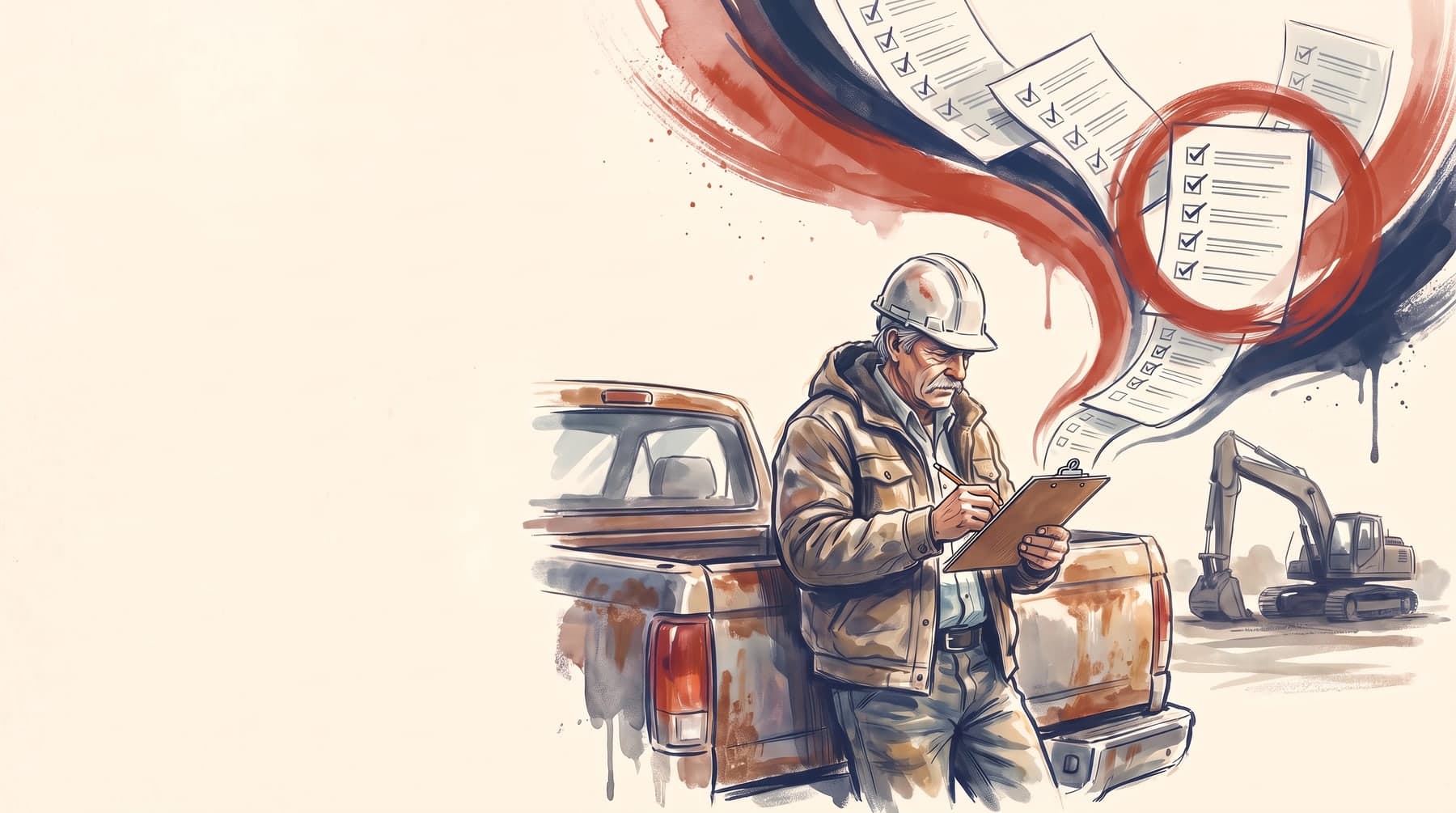
It is 6:40 in the morning. The coffee is still hot, the truck is still running, and the pre-use checklist is done before the door closes. Every box ticked. It was ticked the same way yesterday, and the day before, and every day since spring. On paper, this is a perfect safety record. In practice, nobody looked at anything.
The trade has a name for it: pencil-whipping. It is not slang that safety people invented to scold crews. The US Federal Aviation Administration uses it in its own guidance on maintenance human factors, describing a failed defence as an "independent inspection (the job was 'pencil-whipped' to save time.)" and listing the habit among the norms that make up "one of the dirty dozen in aviation maintenance."1
When the paperwork said it was fine
The cost of a signed-but-not-done check shows up in the most serious investigations. In 2003, Air Midwest Flight 5481 lost pitch control on takeoff at Charlotte, killing all 21 people on board. The NTSB found that a mechanic had bypassed several steps of the elevator rigging procedure with the quality assurance inspector's concurrence, and listed the inspector's failure to detect the incorrect rigging among the contributing causes.2
In 2010, an explosion at the Upper Big Branch mine killed 29 miners. The federal investigation found the operator "kept two sets of books" on safety hazards, and that even where the books showed examinations were done, the examiners "failed to identify obvious hazards."3 In 2017, a dust explosion at a Wisconsin corn mill killed five workers; the company later pled guilty to falsifying its environmental and sanitation logs and paid $10.25 million in restitution and a $1 million fine.4
The record said it was done
Selected investigations| Event | Year | Lives lost | What the paperwork hid |
|---|---|---|---|
| Air Midwest Flight 5481 | 2003 | 21 | Rigging steps bypassed with the inspector's agreement |
| Upper Big Branch mine | 2010 | 29 | Two sets of books; exams that missed obvious hazards |
| Didion corn mill | 2017 | 5 | Falsified environmental and sanitation logs |
Sources: NTSB/AAR-04/01; MSHA Upper Big Branch report (2011); US EPA news release, 16 Feb 2024.
“A checklist that is always perfect is not telling you anything.”
Why good people tick the box
Most pencil-whipping is not fraud. It is what people do when a form asks for more effort than the moment allows. Survey researchers call it satisficing: when answering properly takes real effort, people give an answer that is merely good enough, agree with whatever is in front of them, or stop telling one item from the next and answer them all the same way.5
Length makes it worse. In a study of web questionnaires, the longer the stated length, the fewer people started and finished, and answers to questions near the end were "faster, shorter, and more uniform" than answers near the start.6 NASA's classic study of cockpit checklists found the checklist "highly susceptible to production pressures," leading some pilots to shortcut part or all of the procedure when rushing.7 A forty-item pre-use check at 6:40 a.m. with a schedule to hit is the same problem in a different seat.
The trend that says your data is lying
Here is where the data from Part 1 earns its keep. One of the findings from the Predictive Solutions and Carnegie Mellon inspection research is that too many "100 percent safe" inspections indicate an unsafe site.8 As one trade report put it, if most inspections come back 100% safe, "your organization may be 'flying blind.'"9 Survey science adds a second signal: answering very fast is now used as an indicator of low-quality responses, and "more speeding seems to be universally related to more straightlining," the habit of giving every item the same answer.10
On paper you could never see either signal. You did not know how long a form took, and you could not compare a crew's answers across sixty mornings. Filed digitally, both are free.
Time to complete, one crew
Median minutes per daily checklistIllustrative example, not client data. A steady slide toward seconds, with identical answers, is worth a conversation.
Read the pattern, not the person
Data-quality signalsSignals worth a look
- A form finished far faster than the crew's usual
- Identical answers for weeks at a time
- Months of 100% safe with no findings at all
- Checks filed before the shift started
- A No that is never, ever ticked
What backfires
- Disciplining one quick form
- Leaderboards for perfect scores
- Counting forms instead of findings
- Making a No slower than a Yes
- Adding more questions to catch cheaters
Design it so honesty is the easy path
If a long form invites a fast tick, the fix is not a longer form. It is fewer questions that matter, everything the system already knows filled in, and more questions only when something is actually wrong. A No should be as quick to give as a Yes, and safe to give: a found hazard is the form doing its job. Reward findings, not perfect scores. And when the data shows a crew sliding toward seconds, treat it as a sign the form has stopped fitting their day, not as a verdict on their character.
That is the thinking behind FieldTec's field forms: ask only what the field has to answer, fill in what is already known, and ask more only when something is wrong. And because every form is filed digitally, the signs of a checklist that has stopped meaning anything surface for the people who review them, without anyone having to go hunting.
The point of all this is not catching people. A perfect form usually means the form is wrong for the work, and the people filling it in know it. Make the honest answer the easy one, and the trends in Part 1 become something you can trust.
References
- Federal Aviation Administration (2000). Advisory Circular 120-72, Maintenance Resource Management Training. faa.gov (PDF)
- National Transportation Safety Board (2004). Loss of Pitch Control During Takeoff, Air Midwest Flight 5481, Charlotte, North Carolina, January 8, 2003. NTSB/AAR-04/01. ntsb.gov (PDF)
- Mine Safety and Health Administration (2011). Upper Big Branch Mine-South Fatal Accident Report, Executive Summary. msha.gov (PDF)
- US Environmental Protection Agency (2024). Corn milling company officials sentenced to federal prison for their role in deadly explosion that killed five workers. News release, 16 February 2024. epa.gov
- Krosnick, J.A. (1991). Response strategies for coping with the cognitive demands of attitude measures in surveys. Applied Cognitive Psychology, 5(3), 213–236. doi.org/10.1002/acp.2350050305
- Galesic, M., Bosnjak, M. (2009). Effects of Questionnaire Length on Participation and Indicators of Response Quality in a Web Survey. Public Opinion Quarterly, 73(2), 349–360. doi.org/10.1093/poq/nfp031
- Degani, A., Wiener, E.L. (1990). Human Factors of Flight-Deck Checklists: The Normal Checklist. NASA Contractor Report 177549. ntrs.nasa.gov (PDF)
- Walter, L. (2012). Predictive Analytics and the Four Safety Truths. EHS Today, 22 February 2012. ehstoday.com
- ISHN (2012). Too many "100% safe" inspections predict an unsafe worksite. 21 February 2012. ishn.com
- Zhang, C., Conrad, F.G. (2014). Speeding in Web Surveys: The tendency to answer very fast and its association with straightlining. Survey Research Methods, 8(2), 127–135. doi.org/10.18148/srm/2014.v8i2.5453
FieldTec builds safety software with short field forms and data-quality signals. Charts marked illustrative use example numbers, not client data.
Keep reading